Hi all,
Here are two more sound files from Christine.
Track 27
Track 28
Sunday, November 29, 2009


Food Stamps / Welfare
1. This article from today's NYT is pretty revealing about the experience of taking government assistance like food stamps and welfare. Though it's focused on contemporary issues, I think it sheds bright light on what Helen and Peter are in the midst of, and what Gussie, Jerry, Chicky, and Guy fear. (And perhaps part of what they resent about Rita and Buster's security.)
Be sure to check out the associated slideshow, too.

Be sure to check out the associated slideshow, too.

2. Check out this NPR story from 2007 about a reporter and lawmaker who led a project in which they lived on food stamps -- just $21 a week -- as a way to better understand the plight of America's poor.
Here are two excerpts:
"Rep. JIM McGOVERN (Democrat, Massachusetts; Chairman, House Hunger Caucus): Well, I mean, Lisa and I, you know, one - we normally try to eat fresh vegetables, but fresh vegetables are more expensive than canned vegetables or frozen vegetables. So we have to go with the latter. We - you know, I have a high cholesterol problem, so when I buy a hamburger, I try to buy the leanest meat. Well, the leanest meats are the most expensive and it's not a lot. So we ended up buying the fattiest hamburger because that was quantity, not quality. We bought lentils and beans and pasta and that kind of stuff. And we had small portions. Look, when I go shopping, you know, for the week, if I run out of food on a Thursday or Friday, I go back to the supermarket and buy more. For a lot of people on food stamps, I mean, they don't have that luxury. So, I mean, they have to survive on this food. And I've learned from my food banks back at home in Massachusetts that a lot of people on food stamps supplement their benefit by going to food banks because the cost of gas is so high, utilities are so high. I mean, they're almost living almost exclusively on a food stamp budget. And a lot of people don't know this, including one of my colleagues, but the minimum food stamp benefit is $10 a month. And that hasn't changed since the mid-1970s. So give me a break. I mean, we need to do better."
"Ms. JULIE SIMON (Reporter, KEYTE TV): ...I had to ration four carrots through the whole week. I had absolutely no fresh vegetables. I didn't get to buy the bread that I usually like to buy. I mean, wheat bread is far more expensive than, kind of, processed white. I have one little package of deli meat - also processed - because the fresh, you know, the fresh deli meat is a lot more expensive - a lot of beans and rice, lots of rice, certainly. I mean, you're pretty much eating, I found, the same thing over and over again. ...Absolutely, I did [feel hungry]. I have this kind of gnawing, unsatisfied feeling the whole week. That's kind of how I would describe it. You know, I was able to sustain, although I also lost about three and a half pounds. But I, kind of, always had this unsatisfied feeling following me."
3. And here's some history on the food stamp program itself...
FOOD STAMP PROGRAM. (article by James Tejani)
The food stamp program originated in federal efforts to combat overproduction during the Great Depression by raising the consumption of agricultural products. The Department of Agriculture conceived the program as a means to assist the nation's farmers while also feeding the hungry and out-of-work. The first food stamp program began in May 1939 in Rochester, New York, and eventually spread to 1,500 counties before ending in 1943 as the wartime economic boom dampened concern about hunger and overproduction.
Despite the efforts of a number of proponents, the federal government did not reestablish the food stamp program for nearly twenty years. President John F. Kennedy, after witnessing Appalachian poverty during the 1960 campaign, instructed the Department of Agriculture to create food stamp pilot programs. The first of these began in McDowell County, West Virginia, on 29 May 1961. Its success brought program expansion, and the Food Stamp Act, enacted 31 August 1964, established a permanent program.
Like its predecessor, the second food stamp program served farmers as its primary clientele while assisting the needy through increased purchasing power and food consumption. Participants purchased stamps at prices and at an allotment level determined by their income and received bonus coupons to exchange for food deemed surplus by the government. The program's emphasis on agricultural production, consumption, and consumer choice combined, as President Lyndon B. Johnson observed, America's "humanitarian instincts" with "the free enterprise system."
In the decade following the 1964 legislation, the food stamp program expanded rapidly and transformed from a program of relief and surplus disposal into a welfare program. The Department of Agriculture adapted food stamps to serve the urban poor, liberalized benefits and eligibility to meet nutritional needs, decreased the purchase price of coupons, and increased coupon allotments. The Food Stamp Reform Bill of 1970 codified these reforms and established national standards for nutrition and eligibility. Reforms in 1973 secured food stamps as an entitlement program, required of states and counties by the federal government and guaranteed to all who were eligible. In 1975, the program reached 17.1 million people and received a budget of $4.6 billion. This expansion resulted from the work of hunger advocacy groups, the Senate's Select Committee on Nutrition and Human Needs chaired by George McGovern, and the Nixon administration. It reflected a broad political and social consensus as to the program's necessity, effectiveness, and affordability.
Economic decline in the mid-1970s, however, triggered mounting criticism of the food stamp program. Charges of fraud and abuse, which had worried observers since the creation of the first program, emerged again. New concerns developed from the program's expansion and success. Opponents assailed food stamp benefits and eligibility requirements as too generous and as disincentives for the poor to find work. Conservatives charged that the program had expanded beyond taxpayers' ability to pay for it and represented an outsized federal government. Together, these political attacks brought increased congressional scrutiny and the first turn of public opinion against the program. The Food Stamp Act of 1977 reflected this new mood in stricter eligibility standards and stricter administrative guidelines.
In the 1980s, the Reagan administration and congressional opponents of the food stamp program stepped up efforts to trim the program and dramatically reduced program expenditure. In the course of the decade, the program faced new criticism that blamed food stamps and other welfare programs for enticing illegal and nonworking legal immigrants to the United States. Yet while subjected to budget cuts and redesigned benefits, the program's basic structure and purpose remained unchanged through the 1980s and participation continued to rise. The program reached its peak level of enrollment of 28 million individuals in March 1994.
The mounting hostility of Congress and the public toward food stamps coalesced in the bipartisan Welfare Reform Act of 1996. The legislation cut stamp allotments and eligibility and changed the formula for calculating benefits. While food stamps continued as an entitlement program, the law reduced the federal government's role in funding and administration. It placed a three-month cap on the participation of able-bodied, childless adults who remained unemployed, and it denied benefits to illegal immigrants and to many legal immigrants. The 1996 legislation successfully decreased both the program's cost and its participation levels, but seemed to have shifted much of the difference to private food charities.
The food stamp program remained a significant part of America's struggle against poverty and hunger. In fiscal year 2000, the program served 17.2 million individuals in 7.3 million households and received a budget of $21.1 billion. The Department of Agriculture's Food and Nutrition Service oversaw the program, and state public assistance agencies administered it through their local offices. The program continued to evolve. Electronic benefits systems were replacing the use of stamps, while electoral politics and concerns about access once again seemed to favor program expansion—the restoration of some legal immigrants' benefits, in particular.
Bibliography
Berry, Jeffrey M. Feeding Hungry People: Rulemaking in the Food Stamp Program. New Brunswick, N.J.: Rutgers University Press, 1984. Focuses on federal administration of food stamps yet provides a detailed history of the program's origins and early years.
MacDonald, Maurice. "Food Stamps: An Analytical History." Social Service Review 51 (Dec. 1977): 642–658.
Patterson, James T. America's Struggle against Poverty, 1900– 1994.Cambridge, Mass.: Harvard University Press, 1994.
Department of Agriculture. Food Stamp Program Web site.http://www.fns.usda.gov/fsp. Provides current information and statistics on the program.
Monday, November 23, 2009
Allentown
Ok, this is Pennsylvania-specific, but still has resonance for me with the plight Jerry, Guy, and Peter in the world of this play.
Click to hear the MP3.
Allentown
Billy Joel
Well we're living here in Allentown
And they're closing all the factories down
Out in Bethlehem they're killing time
Filling out forms
Standing in line.
Well our fathers fought the Second World War
Spent their weekends on the Jersey Shore
Met our mothers at the USO
Asked them to dance
Danced with them slow
And we're living here in Allentown.
But the restlessness was handed down
And it's getting very hard to stay.
Well we're waiting here in Allentown
For the Pennsylvania we never found
For the promises our teachers gave
If we worked hard
If we behaved.
So the graduations hang on the wall
But they never really helped us at all
No they never taught us what was real
Iron and coke, chromium steel.
And we're waiting here in Allentown.
But they've taken all the coal from the ground
And the union people crawled away.
Every child had a pretty good shot
To get at least as far as their old man got.
If something happened on the way to that place
They threw an American flag in our face.
Well I'm living here in Allentown
And it's hard to keep a good man down.
But I won't be getting up today.
And it's getting very hard to stay.
And we're living here in Allentown.
My Little Town
Click here to listen to the MP3.
My Little Town
Simon & Garfunkel (1975)
In my little town
I grew up believing
God keeps his eye on us all
And he used to lean upon me
As I pledged allegiance to the wall
Lord I recall
My little town
Coming home after school
Flying my bike past the gates
Of the factories
My mom doing the laundry
Hanging our shirts
In the dirty breeze
And after it rains
There's a rainbow
And all of the colors are black
It's not that the colors aren't there
It's just imagin-ation they lack
Everything's the same
Back in my little town
Nothing but the dead and dying
Back in my little town
Nothing but the dead and dying
Back in my little town
In my little town
I never meant nothin'
I was just my fathers son
Saving my money
Dreaming of glory
Twitching like a finger
On the trigger of a gun
Leaving nothing but the dead and dying
Back in my little town
Repeat and fade:
Nothing but the dead and dying
Back in my little town
Sunday, November 22, 2009
Worth Watching
The first 10 minutes of Scorsese's The Departed. It starts with a flashback to the busing riots in Southie.
Also, CLIFTON: there's a great passing scene with a bunch of Irish mob guys exploding a car by throwing a molotov underneath the chassis. It's probably in the first 30 min or so of the film, but I can't seem to find it on YouTube. If you have time to watch the movie over T-giving break, I recommend it. And Matt Damon does a great Boston accent (not surprisingly).


Saturday, November 21, 2009
An Interesting Point of View...
Taken from The Boston School Integration Dispute: Social Change and Legal Maneuvers by J. Brian Sheehan:
"Hicks and other antibusing leaders had the advantage of being able to draw upon an enormous amount of dissatisfaction and anger, particularly among lower-income whites. Garrity issued his decision as unemployment continued to soar in Massachusetts. By the spring of 1974 the official unemployment rate in Boston was almost 12 percent ( Globe 5/ 5/ 75:1), and unemployment in poor white communities was almost as high as, if not equal to, the unemployment rate in black neighborhoods. In July one man in South Boston stated,
I have some specific reasons for not liking blacks. I came from a really poor family. I'm going to Bridgewater State College in the fall-with no money, no scholarship, no nothing. A black kid can get a scholarship just because he's black, practically. I know it's wrong to discriminate against blacks. But some people, politicians and people in government, seem to think that if we discriminate against whites--and that is poor whites--that makes the black discrimination somehow okay. I feel discriminated against. I resent blacks who get things I can't get, like scholarships, just because they're black. ( Globe 7/ 2/ 74:14)"
Food for thought...
Unemployment in Charlestown in the 1970's
Taken from The Boston School Integration Dispute: Social Change and Legal Maneuvers by J. Brian Sheehan:
The mid- 1970s recession was catastrophic in Boston. In 1976, two years after Judge Garrity's original decision, the city had 33,000 jobless workers with an unemployment rate of 10.8 percent ( City Record 2/ 6/ 78:1). As well as severe unemployment, the city had experienced a major structural shift in the local economy away from blue-collar employment in manufacturing toward service-sector jobs. Employment opportunities in these jobs were severely mismatched with the skill levels of many Boston residents. The decline of Boston's harbor and the integration problems in waterfront neighborhoods such as Charlestown and South Boston have been closely linked with this structural shift in the local economy.
Members of the Massachusetts and Boston public service unions received some of the highest municipal salaries in the country. However, during the recession and fiscal crisis of the mid-70s, with the soaring property tax, the wages and benefits of public service employees became an issue. One effort by Boston to cut labor costs consisted of cutbacks in the number of city workers. At the same time that there was increasing pressure to cut back on the wages, benefits, and numbers of municipal employees, the public service unions also became the subject of affirmative action lawsuits."
More specifically:
"According to the 1960 census, which listed Charlestown's population as 20,147, about 60 percent of the families earned less than $6,000 per year, and 20 percent earned under $3,000 per year. By 1967 the public assistance caseload in Charlestown was about 750. Many of the people, especially those on Aid to Families with Dependent Children (AFDC) and Old Age Assistance, needed rehabilitative help in addition to financial aid. The number of children under eighteen in families on AFDC in 1960 totaled 534 ( John F. Kennedy Family Service Center 1967:10). Unemployment in Charlestown remained higher than the citywide averages. In 1950 the figure was 11.5 percent for Charlestown and 8.7 percent for the city as a whole. In 1960 the jobless rate for males ill the Charlestown labor force was 8.5 percent as contrasted to Boston's rate of 5.5 percent. Of the 2,790 women in the 1960 labor force, 7 percent were unemployed. In the mid-1960s the rate of unemployment for youths in Charlestown was at least double that of adults. It was estimated that at least one fourth of the out-of-school youths under twenty-two were unemployed."
Thursday, November 19, 2009
Evocative Pix
These images are copyright protected, by professional photographer Jerry Berndt, from a series of (mostly Boston) shots he called "Barroom."
Disclaimer: I'm only putting them up here because this is a closed blog, used for research purposes. Please don't download these from here. You can find more info on the Berndt and the series at the website for Akehurst Creative Management.


Disclaimer: I'm only putting them up here because this is a closed blog, used for research purposes. Please don't download these from here. You can find more info on the Berndt and the series at the website for Akehurst Creative Management.


Wednesday, November 18, 2009


the model box


Dan and I met and lit the model box with some of the looks and colors he will be hanging next week, so here are some those images, sorry about the poor quality of some of the pictures
Saturday Night's Alright for Fighting
It's getting late have you seen my mates
Ma tell me when the boys get here
It's seven o'clock and I want to rock
Want to get a belly full of beer
My old man's drunker than a barrel full of monkeys
And my old lady she don't care
My sister looks cute in her braces and boots
A handful of grease in her hair
Don't give us none of your aggravation
We had it with your discipline
Saturday night's alright for fighting
Get a little action in
Get about as oiled as a diesel train
Gonna set this dance alight
'Cause Saturday night's the night I like
Saturday night's alright, alright, alright
Well they're packed pretty tight in here tonight
I'm looking for a dolly who'll see me right
I may use a little muscle to get what I need
I may sink a little drink and shout out "She's with me!"
A couple of the sound that I really like
Are the sounds of a switchblade and a motorbike
I'm a juvenile product of the working class
Whose best friend floats in the bottom of a glass
Fortunate Son
Some folks are born made to wave the flag,
ooh, they're red, white and blue.
And when the band plays "Hail To The Chief",
oh, they point the cannon at you, Lord,
It ain't me, it ain't me,
I ain't no senator's son,
It ain't me, it ain't me,
I ain't no fortunate one, no,
Some folks are born silver spoon in hand,
Lord, don't they help themselves? oh.
But when the taxman come to the door,
Lord, the house look a like a rummage sale, yes,
It ain't me, it ain't me,
I ain't no millionaire's son, no, no.
It ain't me, it ain't me,
I ain't no fortunate one, no.
Yeh, some folks inherit star spangled eyes,
ooh, they send you down to war, Lord,
And when you ask them, how much should we give,
oh, they only answer, more, more, more, yoh,
It ain't me, it ain't me,
I ain't no military son, SON, NO
It ain't me, it ain't me,
I ain't no fortunate one, NO NO
It ain't me, it ain't me,
I ain't no fortunate one, no no no,
It ain't me, it ain't me,
I ain't no fortunate son, son son son
More Music
The 1979 "White Riot" by The Clash -- also in a version by Boston's Dropkick Murphys
White riot - I wanna riot
White riot - a riot of my own
White riot - I wanna riot
White riot - a riot of my own
Black man gotta lot a problems
But they don't mind throwing a brick
White people go to school
Where they teach you how to be thick
An' everybody's doing
Just what they're told to
An' nobody wants
To go to jail!
White riot - I wanna riot
White riot - a riot of my own
White riot - I wanna riot
White riot - a riot of my own
All the power's in the hands
Of people rich enough to buy it
While we walk the street
Too chicken to even try it
Everybody's doing
Just what they're told to
Nobody wants
To go to jail!
White riot - I wanna riot
White riot - a riot of my own
White riot - I wanna riot
White riot - a riot of my own
Are you taking over
or are you taking orders?
Are you going backwards
Or are you going forwards?
White riot - I wanna riot
White riot - a riot of my own
White riot - I wanna riot
White riot - a riot of my own
The Murphys' "For Boston"
The Murphys' "Boys on the Docks"
Say hey Johnny boy, the battle call.
United we stand, divided we fall.
Together we are what we can't be alone,
We came to this country, you made it our home.
This man so humble, this man so brave.
A legend to many, he fought to his grave.
Saved family and friends from the hardship and horror,
in a land of depression he gave hope for tomorrow.
Say Johnny me boy, this ones for you.
With the strength of many and the courage of few.
To what do we owe this man who's fight
was for the masses, he gave his life.
Say hey Johnny boy, the battle call
United we stand, divided we fall.
Together we are what we can't be alone,
We came to this country, you made it our home.
A friend to the locals who dabbled in crime.
He'd give you a job and he'd give you his time.
He wasn't a crook, but he couldn't be conned.
John knew the difference between right and wrong.
Say Johnny me boy, you live no longer,
Others forgotten, your memory's stronger.
Lets drink to the causes in your life:
Your family, your friends, the union, your wife.
Say hey Johnny boy, the battle call.
United we stand, divided we fall.
Together we are what we can't be alone.
We came to this country, you made it our home.
[x2]
And the boys on the docks needed John for sure.
When they came to this country he opened the door.
He said "Man I'll tell ya, they don't like our kind.
Though it starts with a fist it must end with your mind."
Say hey Johnny boy, the battle call.
United we stand, divided we fall.
Together we are what we can't be alone.
We came to this country you made it our home.
White riot - I wanna riot
White riot - a riot of my own
White riot - I wanna riot
White riot - a riot of my own
Black man gotta lot a problems
But they don't mind throwing a brick
White people go to school
Where they teach you how to be thick
An' everybody's doing
Just what they're told to
An' nobody wants
To go to jail!
White riot - I wanna riot
White riot - a riot of my own
White riot - I wanna riot
White riot - a riot of my own
All the power's in the hands
Of people rich enough to buy it
While we walk the street
Too chicken to even try it
Everybody's doing
Just what they're told to
Nobody wants
To go to jail!
White riot - I wanna riot
White riot - a riot of my own
White riot - I wanna riot
White riot - a riot of my own
Are you taking over
or are you taking orders?
Are you going backwards
Or are you going forwards?
White riot - I wanna riot
White riot - a riot of my own
White riot - I wanna riot
White riot - a riot of my own
The Murphys' "For Boston"
The Murphys' "Boys on the Docks"
Say hey Johnny boy, the battle call.
United we stand, divided we fall.
Together we are what we can't be alone,
We came to this country, you made it our home.
This man so humble, this man so brave.
A legend to many, he fought to his grave.
Saved family and friends from the hardship and horror,
in a land of depression he gave hope for tomorrow.
Say Johnny me boy, this ones for you.
With the strength of many and the courage of few.
To what do we owe this man who's fight
was for the masses, he gave his life.
Say hey Johnny boy, the battle call
United we stand, divided we fall.
Together we are what we can't be alone,
We came to this country, you made it our home.
A friend to the locals who dabbled in crime.
He'd give you a job and he'd give you his time.
He wasn't a crook, but he couldn't be conned.
John knew the difference between right and wrong.
Say Johnny me boy, you live no longer,
Others forgotten, your memory's stronger.
Lets drink to the causes in your life:
Your family, your friends, the union, your wife.
Say hey Johnny boy, the battle call.
United we stand, divided we fall.
Together we are what we can't be alone.
We came to this country, you made it our home.
[x2]
And the boys on the docks needed John for sure.
When they came to this country he opened the door.
He said "Man I'll tell ya, they don't like our kind.
Though it starts with a fist it must end with your mind."
Say hey Johnny boy, the battle call.
United we stand, divided we fall.
Together we are what we can't be alone.
We came to this country you made it our home.
Tuesday, November 17, 2009
Brian's "Get-Away" Car

This 1970 GMC Suburban Charter is the type of bus Brian would have taken to skip town. The cost of his ticket would have been around $20.

Baker Street
Another song to add to that mid-late 70s atmosphere...
(reminder: register at Lala.com to hear the whole song here rather than the 30 sec clip)
(reminder: register at Lala.com to hear the whole song here rather than the 30 sec clip)
Monday, November 16, 2009
Away to College
Thanks to help from the Dramaturgs, and a little more digging, John has settled on a likely college for Rita & Buster's kid:
Salve Regina University in Newport, Rhode Island


Salve Regina University in Newport, Rhode Island
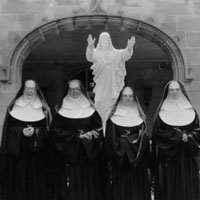
Mission:
As a community that welcomes people of all beliefs, Salve Regina University, a Catholic institution founded by the Sisters of Mercy, seeks wisdom and promotes universal justice. The university through teaching and research prepares men and women for responsible lives by imparting and expanding knowledge, developing skills, and cultivating enduring values. Through liberal arts and professional programs, students develop their abilities for thinking clearly and creatively, enhance their capacity for sound judgment, and prepare for the challenge of learning throughout their lives. In keeping with the traditions of the Sisters of Mercy, and recognizing that all people are stewards of God’s creation, the university encourages students to work for a world that is harmonious, just, and merciful.

The Men
"What about the rights of white people?"
Notice the gentleman in the Patriot outfit -- he's actively referencing the idea that for over 200 years, blood has been spilled on the ground of Charlestown in battles over self-determination and liberty, from the Battle of Bunker Hill onward. The people of Charlestown, those on the bottom of the economic and social scale, will rise up in the face of this injustice as well (ie, forced busing), just as they have done for generations.

Attention Ladies: Check Out This Video
Josh has tipped us off to this great clip from a town hall meeting that was convened in 1985 for Boston residents to discuss the issues brought up in J. Anthony Lukas' book Common Ground (which we have in the rehearsal hall, for those who are interested). This is a particularly good window into the feelings of the community, especially the women.
John says:
The Ladies HAVE TO see that wonderful video of the town mother on the blog. They will not get a better example of who they are playing. The finger, the passion, the accent, it's all there. And the salary quote, I was thinking maybe $13,000, she's saying $11k. So, meatpackers may be up over $12k, but not Jerry.
Anyway that is a must see for the ladies.
Somehow I missed that one in my research...
Beautiful...
Thanks for posting this, Josh!

Boston Celtics Photos
Boston Celtics Photos
1960 World Champions


1973-1974

Team Members:
(John Havlicek, Dave Cowens, Jo Jo White, Don Nelson, Paul Silas, Paul Westphal,
Steve Kuberski, Phil Hankinson, Steve Downing, Art Williams, Henry Finkel)
NBA Most Valuable Players

^Bob Cousy
Years: 1956-1957

^Dave Crowens
Years: 1972-1973

^Bill Russell
Years: 1957-65
Newspaper: Wednesday April 30, 1969

*This link contains annual team photos of the Boston Celtics ranging from 1956-2008 :http://www.nba.com/celtics/history/Championship_60_61.html
More Music
These are 30 second clips, but the whole songs can be heard if you register (for free) at Lala.com.
This song makes me think of Brian...
And here's a classic 1966 Boston song by the Standells -- the one here is a version by current Boston band Dropkick Murphys:
This song makes me think of Brian...
And here's a classic 1966 Boston song by the Standells -- the one here is a version by current Boston band Dropkick Murphys:
Awesome Boston Song
A new song called Knights of Bostonia from local band State Radio. This obviously isn't from the era of the play, but it feels so evocative anyway. Check it out!

Here are the lyrics:
Caught the sun down at Castle Island
Summer spinning its finest gold
They were selling and we were buying
Just looking for someone to hold
I know the feeling of the fight I never saw you blink
We been up against the crab apple sling shot sting
I got my trash can lid on my wing
We're the Knights of the Round Table all
I was working on the straight and narrow
You came at me like a cannonball
I saw you sleeping at the city stables
You made me feel all of ten feet tall
The coming on coming for all the
Rules and the cops and the cold and all
All together and together we fall
Through the cracks in the city street
Through the cracks in the city street
That's right sit straight
And listen up
We are the knights of Bostonia
We'll tell the court you tell the king
That we ain't listening to you no more
We are the knights of Bostonia
Only you can set you free
I would follow you out of the city
Up Dot Ave to Savin Hill
Dock man says the water gonna kill me
Better that than sitting still
Coming on coming for all the
Rules and the cops and the cold and all
All together and together we fall
Through the cracks in the city street
Through the cracks in the city street
That's right sit straight
And listen up
We are the knights of Bostonia
We'll tell the court you tell the king
That we ain't listening to you no more
We are the knights of Bostonia
Only you can set you free
I know the feeling of the fight I never saw you blink
We been up against the crabapple sling shot sting
I got my trash can lid on my wing
We're the Knights of the Round Table all
And we'll fight the coming fall
So sit straight
And listen up
We are the knights of Bostonia
We'll tell the court to tell the king
We ain't listening to you no more
We are the knights of Bostonia
Only you can set you free
Restless nights, the innocent street
A fist to fight, a summer to keep
We are the knights of junkyard raid
The trusty steed and a summer to save
We are the knights of all Bostonia
Together we are the knights
Of all Bostonia
Together we are the knights
Of all Bostonia
Together we are the knights
Of all Bostonia
Sunday, November 15, 2009
John Shea's Aunt in the Phoenix -- 1975
You can access the pdf of the Phoenix article from 1975 that features John's aunt talking about busing in Charlestown.


Meatpacking Video Segment
A video segment from PBS that shows footage of a modern meatpacking plant. Watch this, then think about having to do this work in the 1970s, without the kind of mechanization we have today.
(For those who want a truly brutal picture of the meatpacking industry before it came under regulation, read Upton Sinclair's The Jungle.)


(For those who want a truly brutal picture of the meatpacking industry before it came under regulation, read Upton Sinclair's The Jungle.)
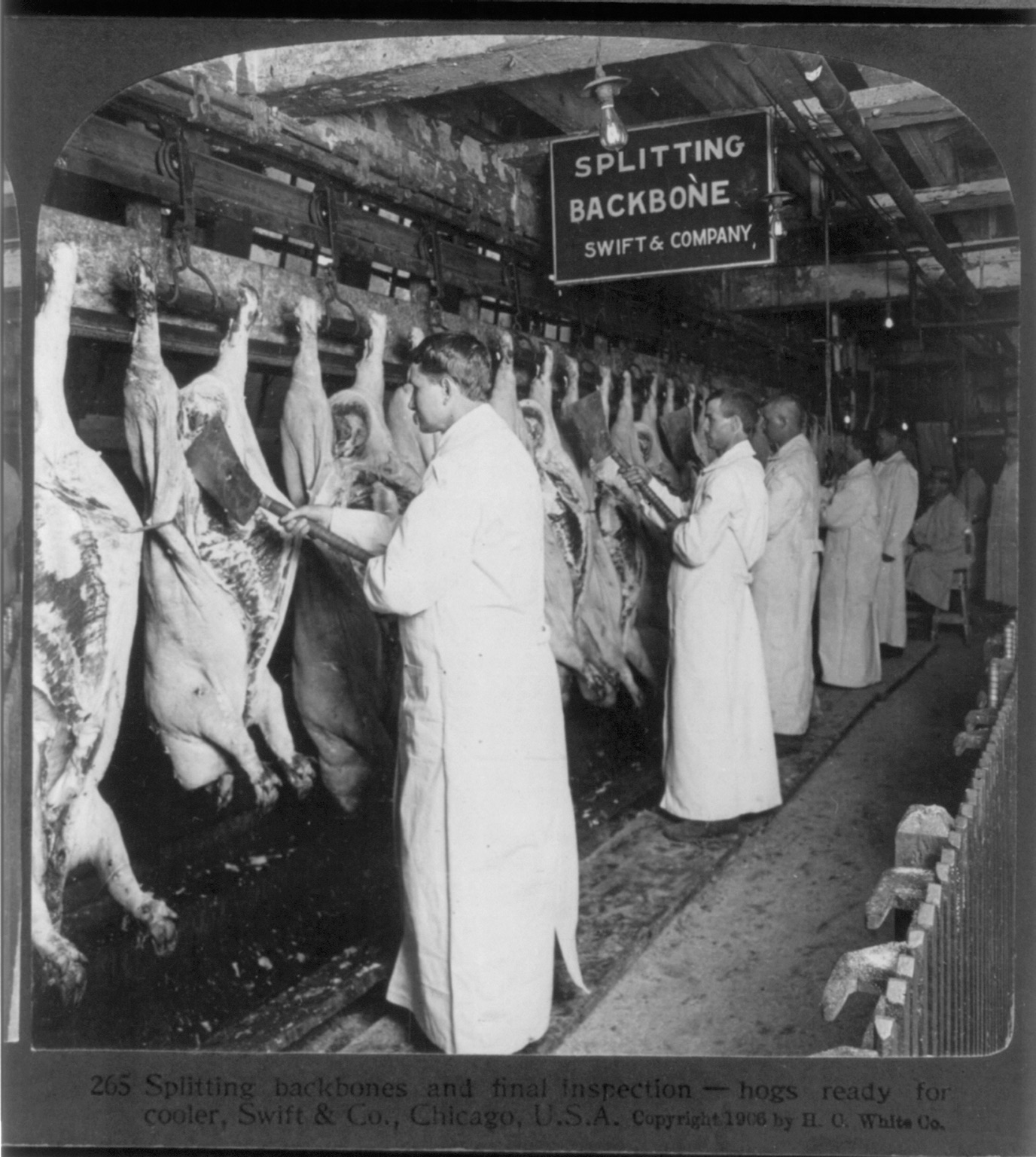


Starter Info on Meatpacking
From the journal Labor (Summer 2008):
[...]
****************************
From PBS's show NOW:
US Meatpacking industry, 1930-1980:
During the 1930s, trade union-organized drives led by the newly-created Congress of Industrial Organizations (CIO) began to organize workers across different industries, including meat packing. Over the next 40 years, unions such as the United Packinghouse Workers of America (UPWA) were able to improve both the pay and working conditions of meat packing employees in the U.S. The UPWA was also known for its progressive ideals and its support of the civil rights movement during the 1960s.
The average wage of animal slaughterers and processors remained comparatively strong from the 1960s through the early 1980s. The average wage earned by a meat packing employee during the 60s and 70s was 14-18 percent higher than their counterpart in the larger U.S. manufacturing sector. The peak average hourly wage of a meat packing employee during this period was nearly $20 an hour when adjusted for inflation.
Technology and Workplace Hazards in
Meatpacking over the Long Twentieth Century
“That Was a Dirty Job!”
Meatpacking has long been one of America’s most dangerous industries. The ubiquitous presence of knives, the severe temperature contrasts between hot killing floors and frigid processing rooms, and the blood, fat, and bodily fluids that spill from animals as they are dismembered — all created an atmosphere of danger to those laboring within. Our cultural sensibilities are shocked by the very presence of an industry given over to death, and it is easy — too easy — to presume that the dangers never change to those who labor in these plants.
Work dangers in meatpacking varied greatly over time and between jobs, reflective of a complex intersection of work processing methods and power relations on the shop floor. The dangers in meatpacking are no longer the same as they were one hundred years ago, but that does not mean the industry is safe. The kinds of dangers have changed, as have the location of the injuries that scar packinghouse workers for the rest of their lives.
[...]
Unionism had as part of its inspiration an effort to curtail workplace dangers such that workers could labor long enough to retire comfortably and avoid crippling injuries that might leave them (and their families) impoverished. Organizers promoted improved workplace safety and working conditions as a union benefit, and workers recalled when such measures accompanied unionization. Armour employee Todd Tate proudly recounted how union pressure had brought about installation of cooling fans in his canned meat department so that workers would not collapse from the heat. “This was a big benefit to the union,” he recalled forty-five years after the incident. Union stewards enforced placement of safety devices on cutting equipment and slowed production speeds to curtail accidents, while union sick leave provisions permitted workers time off with pay in order to prevent small injuries from turning serious.
[...]
Nonetheless, as Tate recalled, “it was still a slaughterhouse!” Meatpacking remained a hard and dirty occupation regardless of unions’ inroads. Official statistics doubtless understated meatpacking’s dangers, emphasizing as they did “disabling” injuries that forced absence from a worker’s principal job. Moreover, after 1950, the meatpacking industry underwent dramatic changes that caused injury rates to rise inexorably. By 1970, meatpacking’s injury rate reached 46.9 percent, three times the average for all manufacturing industries and virtually the same level as in 1943. By then meatpacking had once again secured the dubious honor of America’s most dangerous industry.
[...]
First, meatpacking experienced a technological revolution between 1950 and 1970 that dramatically increased productivity and changed working conditions. Mechanization in the slaughtering and cutting of meat eliminated some of the highest-skilled occupations and created in their place more semiskilled butchering jobs. Processing departments grew rapidly and also drew on new machinery to increase production speeds. Simplification of tasks through more extensive use of machinery and changes in traditional work methods brought more strain on the bodies of packing house workers and increased meatpacking’s propensity for many smaller injuries rather than major ones.
Second, the industry experienced a seismic shift in its corporate structure. The Big Four firms of Armour, Cudahy, Swift, and Wilson that had dominated the industry since 1900 faced new competition. Some were unionized firms, such as Oscar Mayer, which specialized in processed pork products, while others, such as Iowa Beef Processors (later IBP), specialized in beef slaughtering. By 1962, the Big Four controlled just 38.1 percent of meat sales in the United States, whereas they had dominated with 78 percent in 1937.
Although the data do not help discern the relative contribution of these two factors to the injury rate, there is clear continuity in meatpacking’s characteristic profile of more frequent but less severe injuries. In 1960, packinghouse workers suffering disabling injuries averaged thirty-four days off work. Over the next ten years, the average duration of work absences per injury fell to twenty-five days even as the aggregate injury rate rose 60 percent. In 1970, meatpacking employees were three times more likely as other industrial workers to get injured on the job. Yet when they were forced to take time off, the number of days they needed to recuperate was one-half the national average.
****************************
From PBS's show NOW:
US Meatpacking industry, 1930-1980:
During the 1930s, trade union-organized drives led by the newly-created Congress of Industrial Organizations (CIO) began to organize workers across different industries, including meat packing. Over the next 40 years, unions such as the United Packinghouse Workers of America (UPWA) were able to improve both the pay and working conditions of meat packing employees in the U.S. The UPWA was also known for its progressive ideals and its support of the civil rights movement during the 1960s.
The average wage of animal slaughterers and processors remained comparatively strong from the 1960s through the early 1980s. The average wage earned by a meat packing employee during the 60s and 70s was 14-18 percent higher than their counterpart in the larger U.S. manufacturing sector. The peak average hourly wage of a meat packing employee during this period was nearly $20 an hour when adjusted for inflation.
Subscribe to:
Posts (Atom)
